Wildfire changes the way people should think about trees. Under ordinary conditions, a mature tree adds shade, privacy, stormwater control, and value to a property. Under extreme fire weather, that same tree can become a ladder for flames, a source of embers, or a heavy hazard over a roofline and access road. The work is not simply about cutting vegetation back until a property looks bare. Good wildfire mitigation protects structures without sacrificing healthy trees that can still play an important role in the landscape.
That balance is where experience matters. Homeowners often assume wildfire mitigation means full clearing, aggressive topping, or taking out every large tree near a building. In practice, the safest properties are usually managed, not stripped. Species selection, canopy spacing, crown condition, deadwood removal, slope, wind direction, ladder fuels, roof type, and access for fire crews all matter. A property with thoughtful Tree Pruning & Crown Shaping and selective removals often performs better than one where rushed clearing Dangerous Tree Assessment and Removal leaves stumps, resprouting brush, exposed soils, and neglected trees in decline.
Wildfire Mitigation Tree Services sit at the intersection of arboriculture, defensible space planning, and hazard reduction. The objective is to reduce fire intensity around homes, outbuildings, driveways, fences, and utility corridors while preserving the most resilient trees whenever possible.
Why trees matter in wildfire behavior
Not every tree presents the same fire risk. A healthy, well-spaced tree with a moist canopy and proper clearance from structures can be an asset. Dense clusters of low branches, dead needles, accumulated leaf litter, and contiguous canopies are different. Those conditions let fire climb from the ground into the crowns, then spread rapidly overhead.
One of the most common issues on residential lots is the ladder fuel problem. Ground fire often starts in dry grass, mulch, pine straw, or ornamental shrubs. If low limbs hang close to those fuels, flames can move into the tree canopy. Once a crown ignites, heat output rises dramatically. That can shatter windows, ignite siding, and throw embers onto roofs, decks, and attic vents. I have seen properties where the main trunk survived, but the real damage came from a neighboring tree crown torching and showering embers onto the structure.
The arrangement of trees matters almost as much as the species. Conifers planted too close together can create continuous fuel beds. Broadleaf trees, depending on health and maintenance, often behave differently, but dead branches, poor structure, and proximity to the house can still make them dangerous. A tree thirty feet from a structure is not automatically safe, especially if wind, slope, and overhanging branches bring heat and ember exposure closer than the owner realizes.
Defensible space is not one-size-fits-all
A flat suburban lot and a steep wooded hillside demand different decisions. So do high desert communities, mixed oak woodlands, and mountain neighborhoods with dense pines. The broad principle is to interrupt fire pathways, reduce available fuel, and improve the odds that firefighters can safely defend the property if conditions allow.
On steeper slopes, flames can preheat vegetation upslope, making fire spread faster and more intense. Trees that might be acceptable on level ground can become serious hazards on a grade. Wind exposure changes priorities too. In ember-driven fires, the issue may not be direct flame contact at first. Instead, embers land in dry debris caught in gutters, bark mulch against siding, needle buildup under decks, or old stump cavities full of combustible material. That is why wildfire planning should look beyond the obvious headline trees and consider the whole fuel picture.
This is also where a Certified Arborist Consultation earns its keep. An arborist with wildfire mitigation experience can evaluate tree health, structure, species behavior, and site conditions together, rather than recommending blanket removals that solve one problem while creating another.
The difference between healthy canopy management and overcutting
The rush to reduce vegetation often leads property owners to make trees less safe, not more. Topping is a prime example. People cut a large tree back hard, believing a lower tree is a safer tree. In reality, topping can trigger weakly attached regrowth, expose limbs and bark to sun injury, and accelerate decline. Within a few seasons, the property may have a stressed tree with dense epicormic shoots and a more brittle structure than before.
Good Tree Pruning & Crown Shaping for wildfire mitigation is deliberate. The work targets deadwood, weak attachments, excess density in specific areas, and low branches that connect ground fuels to the crown. It also respects species tolerance, wound size, seasonal timing, and long-term structure. If a tree can be retained safely with pruning and spacing adjustments, that is often preferable to removing it outright.
There are trade-offs. Raise the canopy too aggressively and you may destabilize the tree’s form, expose the trunk, or encourage undesirable understory growth. Leave the canopy too low and you maintain a direct fire ladder. The right answer depends on tree size, species, vigor, surrounding fuels, and proximity to structures.
When Tree Removal Services are the safest option
Some trees should not stay. Wildfire planning is not sentimental work when a tree is already compromised. A dead conifer near a home, a large trunk with advanced decay over a driveway, or a fire-scarred tree leaning toward a structure may call for removal even if the canopy still looks partly green.
Dangerous Tree Assessment and Removal usually becomes necessary under a few recurring conditions:
- the tree is dead, dying, or structurally unsound near a home, road, or utility line the canopy overhangs roofs, chimneys, or vulnerable attachments in a way pruning cannot reasonably fix the tree sits within a dense fuel cluster where spacing cannot be created without selective removal roots, decay, or previous damage have made failure likely during fire weather or emergency access operations species and site conditions make long-term maintenance impractical compared with replacement
Tree Removal Services in wildfire zones should be surgical. The goal is not to clear every mature tree, but to remove the ones that materially increase fire spread or structural risk. Mature shade trees can still have a place on a property if they are healthy, properly spaced, and maintained with defensible space in mind.
An experienced crew also plans for where the debris goes. Felling a hazard tree and leaving slash piles nearby defeats the purpose. Limbs, tops, and chips need to be handled in a way that does not create a new fuel load.
Stumps, roots, and the often-overlooked fuel problem
After removals, many owners stop at the visible part of the job. The trunk is gone, so they assume the hazard is gone. That is not always true. Old stumps collect dry bark, resin-rich material, needles, leaves, and rodent nesting debris. In some landscapes, stump cavities become ideal ember traps. Once ignited, they can smolder for long periods.
Stump Removal & Grinding is often a practical next step, especially near structures, decks, propane tanks, sheds, fences, and primary walkways. Grinding does not remove every root, but it lowers the stump profile, reduces ember-catching voids, and makes it easier to manage the surrounding area with noncombustible ground cover or low-fuel plantings.
There is judgment involved here as well. On a remote edge of a large property, stump grinding may not be urgent if the stump sits far from assets and access routes. Near the house, it usually makes sense. If the stump belongs to a species that readily resprouts, grinding or follow-up management becomes even more important. Otherwise, the property owner may trade one hazard for a thicket of new shoots.
Crown spacing, limb height, and the practical side of pruning
A lot of wildfire mitigation work comes down to spacing. Not arbitrary spacing, but spacing that breaks continuity in the available fuel. That may mean increasing separation between tree crowns, thinning dense clusters, or selecting a few removals that significantly reduce overall hazard.
I have walked properties where three small removals changed the entire risk profile. One suppressed pine leaning toward the garage, one crowded cedar at the fence line, and one declining ornamental beside the propane enclosure. Once those were out, the retained trees could be pruned properly, crown separation improved, and emergency access opened up. The owners expected a major clearing project. What they actually needed was a focused plan.
Lower limb pruning is similar. Raise limbs too much and the landscape starts to look scalped. Raise them too little and the ladder fuel remains. The right clearance depends on local conditions, but the principle is straightforward: keep enough separation between surface fuels and canopy fuels that a ground fire has a harder time climbing. That should be coordinated with shrub management, mulch choice, and leaf litter control, otherwise the pruning loses much of its benefit.
When Tree Cable and Bracing makes sense
Not every at-risk tree needs removal. A structurally valuable tree with a co-dominant stem, included bark, or a heavy lateral over a target may still be retainable. Tree Cable and Bracing can reduce the chance of failure in some cases, particularly where the tree has high landscape value and good overall health.
This is not a fireproofing measure by itself. A cable will not stop flame spread. What it can do is help preserve a tree that might otherwise fail under wind load, drought stress, or post-fire weakening. In wildfire country, cable and bracing are best understood as part of a broader risk management plan. If the canopy still overhangs a shake roof or the understory remains packed with flammable material, support hardware alone does not solve the real problem.
The decision to install support systems should come from a Certified Arborist Consultation, ideally with someone who understands both structural dynamics and fire behavior around buildings. Hardware needs inspection over time, and not every defect is a candidate for correction.
Emergency Tree Services after wind, drought, and fire events
Wildfire risk rarely arrives alone. Drought, beetle pressure, root disease, winter storm damage, and summer wind events often weaken trees before the fire season peaks. Then one lightning strike, one dry cold front, or one fast-moving grass fire turns a marginal tree into an immediate threat.
Emergency Tree Services are especially important after near-miss events. A tree that took heat on one side may not fail that day, but internal damage can show up later. Cambium death, root injury, bark splitting, and delayed canopy dieback often develop over months. Property owners frequently look at surviving green foliage and assume the tree is fine. Sometimes it is. Sometimes the roots were cooked enough that the tree becomes unstable in the next storm.
Rapid post-incident assessment helps sort salvageable trees from those that need prompt action. Access roads should get priority. Fire apparatus and evacuation routes cannot function well with hung-up limbs, leaning trunks, or partially failed trees over driveways. A blocked road at the wrong time turns a manageable emergency into a dangerous one.
What a good mitigation visit should cover
A real mitigation assessment looks at more than tree count and branch height. It should consider structure proximity, roof and vent exposure, species mix, crown condition, deadwood, slope, prevailing winds, understory continuity, driveway clearance, and likely ember accumulation zones. The best recommendations are specific to the property, not copied from a generic checklist.
A useful site visit usually includes discussion of which trees to retain, which to prune, which to remove now, and which to monitor. Timing matters too. Heavy work in peak heat or active bird nesting periods may require adjustments. In some communities, permits or local defensible space standards also shape the plan.
Here is the kind of sequence that works well on many properties:
- assess tree health, structure, and spacing in relation to the home and access routes complete priority pruning and Dangerous Tree Assessment and Removal first address Stump Removal & Grinding and slash disposal so fuel is not left behind revisit understory fuels, irrigation, mulch, and maintenance intervals schedule reinspection, especially after drought, storms, or nearby fire exposure
That final step is the part many owners skip. Trees grow, conditions change, and a mitigation plan from four or five years ago may no longer reflect current risk.
Preserving the trees worth keeping
There is a tendency in fire-prone areas to frame the conversation as trees versus safety. That is the wrong framing. The real choice is unmanaged vegetation versus informed management. Healthy trees, placed and maintained well, can shade roofs and walls, moderate summer heat, slow wind near the ground, and support a more stable landscape. They may even reduce flashy surface fuel growth by changing site conditions. But that only holds true when the trees are in the right places and kept in the right condition.
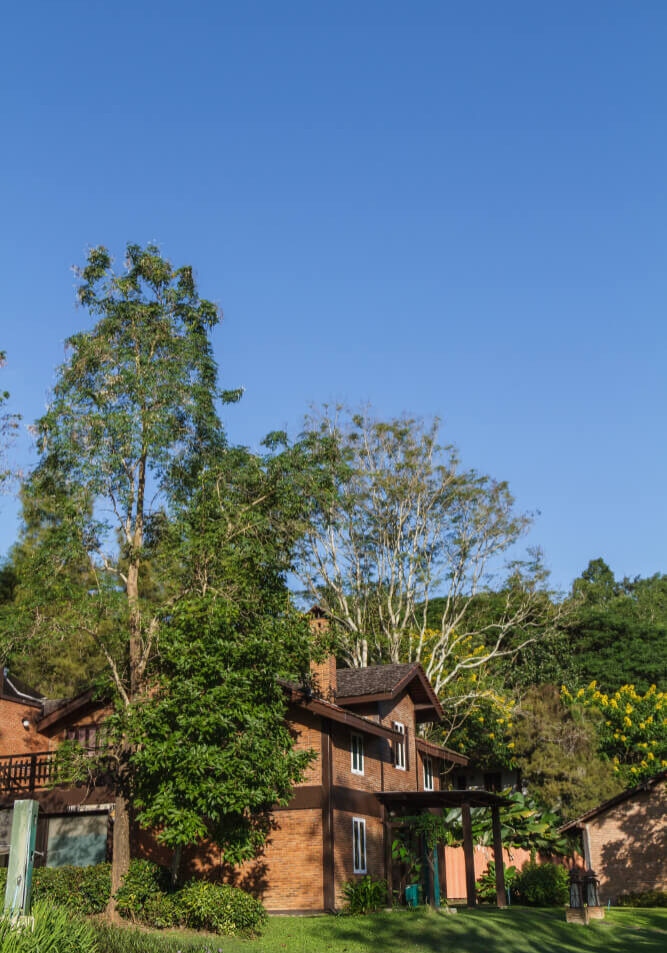
Preservation starts with choosing candidates wisely. Trees with good structure, strong species suitability, adequate spacing, and no major defects are usually worth investing in. Those with chronic dieback, severe lean, root plate movement, advanced decay, or repeated branch failures often are not. Sometimes the most cost-effective path is to remove a high-maintenance, high-risk tree and replace it with a lower-fuel species planted farther from the structure.
This is also where pruning aesthetics should not be ignored. Poor wildfire work can leave a property looking hacked apart, which often leads owners to stop maintenance altogether. Thoughtful Tree Pruning & Crown Shaping can reduce risk while preserving the form of the tree and the character of the site. That matters, especially in established neighborhoods where mature canopy is part of the value of the property.
Cost, timing, and the price of delay
Wildfire mitigation is usually cheaper when done proactively. A planned pruning and selective removal project costs less than emergency work after a storm, after a red-flag warning panic, or after partial fire damage. Emergency Tree Services often involve more labor, higher risk, harder access, and tighter scheduling. Insurance does not necessarily cover preventive work, and waiting until a tree becomes an obvious danger narrows your options.
Seasonal timing affects both tree response and crew efficiency. In many regions, late winter through spring is a practical window for assessment and planning, before peak fire season and before contractors book out. Summer can still be appropriate for some work, but fire restrictions, heat stress, and local conditions may limit operations. Fall may reveal drought impacts clearly, making it easier to identify decline that was less obvious earlier in the year.
There is also the hidden cost of fragmented work. Hiring one company to remove a tree, another to grind the stump, and leaving slash cleanup for later often results in delays and unfinished fuel problems. Integrated Wildfire Mitigation Tree Services tend to produce better results because the plan is coherent from assessment through cleanup.
Common mistakes property owners make
The most expensive errors are often the simplest ones. People focus on the biggest trees and ignore the smaller fuels that actually carry fire to those trees. They store firewood under the eaves. They let volunteer saplings fill the space under mature canopy. They postpone the removal of a dead tree because it still provides privacy. They prune branches away from windows but leave them over the roof. They chip material and spread it too deeply beside the house. None of those choices seems dramatic on its own, but together they create continuity of fuel.
Another mistake is assuming every arborist or tree crew approaches wildfire risk the same way. Some are excellent climbers and removals specialists but less experienced in defensible space strategy. Others understand vegetation management broadly but may not evaluate tree structure with enough nuance. The strongest results usually come from crews who combine practical tree work with arboricultural judgment and local fire awareness.
A property is never finished
Wildfire mitigation is maintenance, not a one-time event. Trees add growth every year. Shrubs fill in. Needles fall. Drought shifts vigor. Wind opens one side of a canopy and loads another. New fences, sheds, pergolas, and patio covers create fresh exposure points. A property that was reasonably well prepared three years ago can drift back into a risky condition without anyone noticing.
That is why periodic reassessment matters. For some sites, an annual walk-through is enough. For others, especially heavily wooded lots or drought-stressed landscapes, more frequent review is justified. The goal is not perfection. It is to keep fuel conditions and tree hazards from accumulating quietly until the next fire weather event exposes every neglected detail at once.
The best wildfire mitigation work leaves a property looking intentional. Trees are still present, but they are healthier, better spaced, and less likely to carry fire to the home. Access is clearer. Dead material is gone. Stumps are not smoldering ember traps. The canopy no longer hangs over vulnerable parts of the structure. And the owner understands what needs to be watched next.
That is what professional Wildfire Mitigation Tree Services should deliver: reduced fire risk, retained landscape value, and a plan grounded in how trees actually behave on real properties under real stress.
Name: Ace Tree Services Ltd.
Address: 4656 Wallace Hill Rd, Kelowna, BC V1W 4C2, Canada
Phone: 250-212-9593
Website: https://acetree.ca/
Email: [email protected]
Hours:
Sunday: Closed
Monday: 7:00 AM–5:00 PM
Tuesday: 7:00 AM–5:00 PM
Wednesday: 7:00 AM–5:00 PM
Thursday: 7:00 AM–5:00 PM
Friday: 7:00 AM–5:00 PM
Saturday: 7:00 AM–5:00 PM
Time zone: Pacific Time
Open-location code / Plus code: RHF8+8G Kelowna, British Columbia, Canada
Map/listing URL: https://www.google.com/maps/search/?api=1&query=Google&query_place_id=ChIJxRVIBx2LfVMRNRSkp6-IC0U
Embed iframe:
Socials:
https://www.facebook.com/p/Ace-Tree-Services-61585901931447/
Ace Tree Services Ltd. provides professional tree care from its Kelowna location on Wallace Hill Road.
The official website lists tree removal, stump removal and grinding, tree pruning and crown shaping, emergency tree services, certified arborist consultation, dangerous tree assessment and removal, tree cabling and bracing, and wildfire mitigation.
Ace Tree Services serves homeowners, businesses, and property owners in Kelowna and throughout the Okanagan Valley.
The company’s official site highlights ISA Certified Arborist support, local Okanagan experience, and fully insured tree service work.
Customers can contact Ace Tree Services for planned tree maintenance, high-risk removals, storm-related tree concerns, pruning, stump grinding, and arborist consultation needs.
The supplied public listing address is 4656 Wallace Hill Rd, Kelowna, BC V1W 4C2, near rural and residential service areas in southeast Kelowna.
For tree services in Kelowna and the Okanagan, call 250-212-9593, email [email protected], or visit https://acetree.ca/
The public map listing uses plus code RHF8+8G Kelowna, British Columbia, Canada and can help customers find Ace Tree Services Ltd. near Wallace Hill Road.
Popular Questions About Ace Tree Services Ltd.
What does Ace Tree Services Ltd. do?
Ace Tree Services Ltd. provides tree removal, stump removal and grinding, tree pruning and crown shaping, emergency tree service, certified arborist consultation, dangerous tree assessment and removal, tree cabling and bracing, and wildfire mitigation.
Where is Ace Tree Services Ltd. located?
Ace Tree Services Ltd. is listed at 4656 Wallace Hill Rd, Kelowna, BC V1W 4C2, Canada.
What phone number should customers call?
Customers can call Ace Tree Services Ltd. at 250-212-9593.
What is the email address for Ace Tree Services Ltd.?
The supplied email address is [email protected].
What are Ace Tree Services Ltd.’s hours?
The supplied listing hours show Monday through Saturday from 7:00 AM to 5:00 PM, with Sunday closed, Pacific Time. The official website lists 7:00 AM to 5:00 PM, Monday through Friday, so customers should confirm Saturday availability before booking.
Does Ace Tree Services Ltd. provide emergency tree service?
Yes. The official website lists emergency tree services, including emergency tree removal, dangerous tree assessment, emergency stabilization, and limb or branch cleanup.
Does Ace Tree Services Ltd. offer arborist consultations?
Yes. The official services page lists certified arborist consultation as one of the company’s Okanagan tree services.
Does Ace Tree Services Ltd. provide stump grinding?
Yes. The official services page lists stump removal and grinding as a service.
What areas does Ace Tree Services Ltd. serve?
The official website states that Ace Tree Services serves Kelowna and the Okanagan Valley.
How do I contact Ace Tree Services Ltd.?
Call 250-212-9593, email [email protected], visit https://acetree.ca/, or use the listed social profile: Facebook.
Landmarks Near Kelowna, BC
Wallace Hill Road: The road listed for Ace Tree Services Ltd. and a practical reference point for the company’s Kelowna location.
East Kelowna: A nearby rural and residential area where tree maintenance, pruning, removals, and wildfire mitigation can be important for property owners.
Myra-Bellevue Provincial Park: A major outdoor landmark southeast of Kelowna and a useful reference for the surrounding hillside and forested areas.
Gallagher’s Canyon: A nearby Kelowna community with residential properties, mature trees, and landscape maintenance needs.
Kettle Valley: A southeast Kelowna neighborhood with homes, parks, and landscaped properties.
Mission Creek Greenway: A well-known natural corridor in Kelowna and a local reference point for tree-lined recreation areas.
Orchard Park Shopping Centre: A major Kelowna retail landmark and citywide reference point.
Downtown Kelowna: A central business and residential district within Ace Tree Services’ broader Kelowna service area.
Okanagan Lake: A major regional landmark running through Kelowna and the surrounding Okanagan Valley.
Mission Creek Regional Park: A recognizable Kelowna park and natural landmark with extensive trees and trails.
Rutland: A large Kelowna community with residential and commercial properties that may need tree service support.
Glenmore: A Kelowna neighborhood with homes, parks, and established trees.
Lower Mission: A residential and lake-adjacent Kelowna area where pruning, tree health, and property safety can matter for homeowners.
Kelowna International Airport: A major transportation landmark north of central Kelowna.
West Kelowna: A nearby Okanagan community across the lake and a practical regional service reference.
For tree removal, stump grinding, pruning, crown shaping, emergency tree service, arborist consultation, dangerous tree assessment, cabling and bracing, or wildfire mitigation near these Kelowna and Okanagan landmarks, contact Ace Tree Services Ltd. at 250-212-9593, email [email protected], or visit https://acetree.ca/